Chef Course in Dehradun 2026: Why 80% Practical Training is Better Than Theory
If you are planning to build a career as a professional chef, choosing the right chef course in Dehradun is an important first step. The hospitality and food industry is becoming increasingly skill-oriented, and employers are looking for candidates who can perform practical tasks confidently rather than simply having theoretical knowledge.
A good culinary education should therefore provide a combination of classroom knowledge and extensive practical exposure.
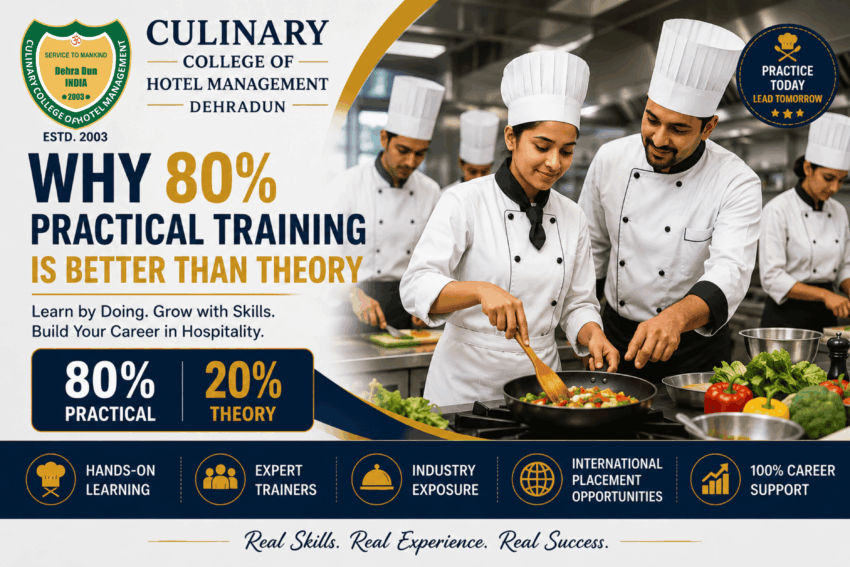
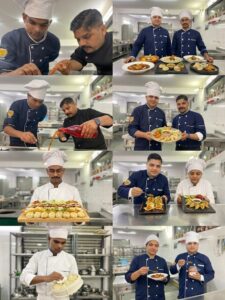
At Culinary College of Hotel Management, Dehradun, our practical-oriented approach focuses on developing industry-relevant skills through hands-on training. The objective is simple: learn the concept, practise the skill and develop the confidence required for a professional career.
In this article, we explain why 80% practical training and 20% theory can be an effective approach for students who want to pursue a career in culinary arts, hotel management, bakery, restaurants, resorts and international hospitality.
What is a Chef Course?
A chef course is a professional hospitality programme designed to teach students the knowledge and practical skills required to work in professional kitchens and food-production environments.
Depending on the programme, students may learn:
- Indian cuisine
- Chinese cuisine
- Continental cuisine
- Tandoor
- Bakery and pastry
- Food preparation
- Knife skills
- Kitchen organisation
- Food safety and hygiene
- Food presentation
- Menu planning
- Food costing
- Kitchen management
- Basic hospitality operations
A strong chef course in Dehradun should not be limited to classroom lectures. Students should have regular opportunities to practise these skills under the guidance of experienced trainers
Why 80% Practical Training is Better for Culinary Students
Hospitality is a practical profession.
A chef does not spend the working day writing about cooking techniques. A chef needs to prepare ingredients, operate kitchen equipment, follow recipes, maintain hygiene, coordinate with colleagues, manage time and produce food according to professional standards.
This is why practical training is so important.
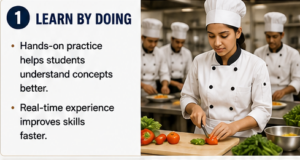
1. Learn by Doing
Students understand skills much faster when they actually perform them.
For example, reading about knife cuts is different from holding a professional knife and repeatedly practising julienne, brunoise, dice and other cutting techniques.
Similarly, reading about sauces cannot replace actually preparing them.
Practical training allows students to:
- Perform tasks themselves
- Understand professional techniques
- Identify mistakes
- Receive feedback
- Repeat the process
- Improve their performance
This creates a much stronger learning experience.
2. Practical Training Builds Professional Confidence
Many students feel nervous when they enter a professional kitchen for the first time.
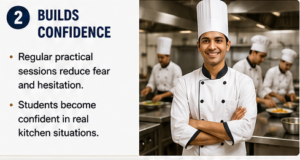
Regular practical sessions help reduce this hesitation.
When students repeatedly practise food preparation, cooking, plating and kitchen procedures, they gradually become more confident.
Confidence is particularly important in hospitality because kitchens and restaurants can be fast-paced environments.
A student who has already practised under supervision is better prepared to face real workplace situations.
3. Practical Training Makes Students More Job-Ready
The main objective of professional education should be to prepare students for their future careers.
Employers generally need people who can contribute to the workplace.
A student who has received extensive practical exposure may already have experience with basic professional procedures such as:
- Mise en place
- Kitchen hygiene
- Food preparation
- Cooking techniques
- Kitchen organisation
- Food presentation
- Team coordination
- Time management
- Basic costing
This practical foundation can make the transition from college to industry easier.

Why Theory Still Matters
Does 80% practical training mean theory is unnecessary?
No.
Theory remains an important part of professional education.
Students need theoretical knowledge to understand the principles behind what they are doing.
For example, students should understand:
- Why food safety is important
- Why particular cooking methods are used
- How food costing works
- How kitchen departments are organised
- How menus are planned
- How hospitality businesses operate
- How nutrition affects food preparation
Therefore, the ideal approach is not practical versus theory.
It is:
Theory + Practical Training = Professional Skill Development
The 20% theoretical component provides the foundation, while the 80% practical component gives students the opportunity to apply that knowledge.
What Do Students Learn in Practical Culinary Training?
A comprehensive culinary programme should expose students to a variety of kitchen activities.
Food Preparation
Students learn how to select, clean, cut, prepare and organise ingredients before cooking.
Indian Cuisine
Students can develop knowledge of traditional Indian ingredients, cooking methods, gravies, breads, rice preparations and regional dishes.
Chinese Cuisine
Students can learn basic Chinese cooking techniques, sauces, noodles, rice preparations and stir-frying.
Continental Cuisine
Students can practise international cooking techniques, soups, sauces, vegetables, meat preparations and plating.
Tandoor
Tandoor training introduces students to traditional Indian cooking techniques involving breads, vegetables and other preparations.
Bakery & Patisserie
Students interested in baking can develop practical knowledge of bread, cakes, pastries, cookies and other bakery products.
Students specifically interested in baking can also explore our Bakery & Patisserie Courses in Dehradun.
Chef Course in Dehradun: Why Choose Practical-Oriented Education?
When comparing different institutes, students should not look only at the course name or certificate.
It is important to ask:
How much practical training is actually provided?
A practical-oriented institution should provide students with opportunities to work with kitchen equipment, ingredients and professional procedures.
Students should also look for:
- Practical kitchen sessions
- Experienced faculty
- Industrial training
- Industry exposure
- Soft-skill development
- Communication training
- Grooming
- Placement assistance
- Career counselling
- Exposure to different cuisines
These factors can contribute significantly to a student’s professional development.
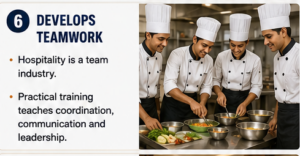
Hotel Management Course in Dehradun and Practical Learning
Practical education is not limited to culinary training.
Students pursuing a hotel management course in Dehradun also need practical exposure to different hotel departments.
These may include:
Food Production
Students learn kitchen operations, food preparation, cooking methods and hygiene.
Food & Beverage Service
Students learn table setup, service techniques, guest interaction and restaurant operations.
Front Office
Students learn the fundamentals of reservations, check-in, check-out, guest communication and front-office procedures.
Housekeeping
Students learn room preparation, cleanliness standards, housekeeping procedures and hotel hygiene.
By experiencing different departments, students gain a broader understanding of how hotels and hospitality businesses operate.
If you are interested in hotel management education, explore our Hotel Management Courses in Dehradun.
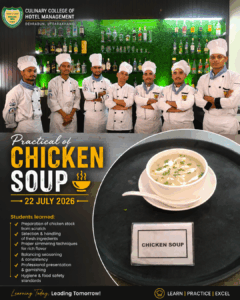
Industrial Training: Taking Practical Learning Beyond the Classroom
College practical sessions provide the foundation, but industrial exposure can take learning one step further.
Industrial training allows students to experience the professional hospitality environment and understand how hotel departments function on a daily basis.
Students can observe:
- Professional kitchen operations
- Restaurant service
- Guest handling
- Hotel standards
- Workplace discipline
- Department coordination
- Professional communication
This experience can help students understand the difference between classroom learning and real-world hospitality operations.
International Career Opportunities After a Chef Course
One of the attractions of culinary and hospitality careers is the possibility of working in different parts of the world.
Depending on qualifications, experience, employer requirements and applicable immigration/work regulations, hospitality professionals may explore opportunities in international markets such as:
- UAE
- Mauritius
- Maldives
- Thailand
- France
- Germany
- Japan
- Cruise hospitality
International exposure can help professionals develop their skills, understand different cultures and gain experience with global hospitality standards.
However, students should always verify the actual employment terms, visa requirements and employer details before accepting an overseas opportunity.
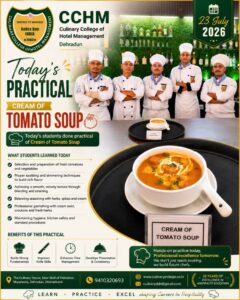
Why Culinary College of Hotel Management, Dehradun?
Culinary College of Hotel Management has been associated with hospitality education in Dehradun since 2003.
Over the years, the institute has focused on practical hospitality education and career-oriented training.
Our approach is based on the idea that students should not only study hospitality—they should practise it.
Students can develop practical exposure in areas such as:
- Culinary arts
- Food production
- Bakery and pastry
- Food & beverage service
- Hotel operations
- Hospitality skills
- Professional communication
- Industry training
For students searching for a chef course in Dehradun, the focus on hands-on learning can be an important factor when comparing institutes.
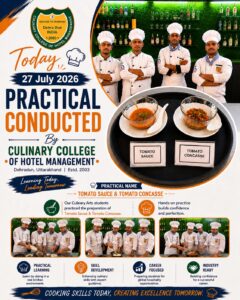
Who Should Choose a Chef Course?
A culinary or chef course can be suitable for students who:
- Enjoy cooking and food preparation
- Want to become professional chefs
- Are interested in hotels and restaurants
- Want to work in resorts
- Are interested in cruise hospitality
- Want to explore international hospitality careers
- Want to start a food-related business
- Prefer practical learning
You do not necessarily need to be an expert cook before joining a culinary programme.
Professional training is designed to help students develop their skills step by step.
Career Options After a Culinary Course
After completing a relevant culinary or hospitality programme and gaining appropriate experience, students can explore career paths such as:
- Commis Chef
- Chef de Partie
- Kitchen Supervisor
- Bakery Assistant
- Pastry Chef
- Food Production Professional
- Restaurant Professional
- Catering Professional
- Kitchen Entrepreneur
Career progression depends on skills, experience, qualifications, performance and the employer.
How to Choose the Best Chef Course in Dehradun
Before taking admission, consider these factors:
1. Practical Training
Ask how many hours students actually spend in practical sessions.
2. Course Curriculum
Check whether the curriculum covers the skills relevant to your career goals.
3. Industrial Training
Find out whether the course includes industry exposure or training.
4. Faculty
Experienced trainers can provide practical guidance and professional insights.
5. Infrastructure
Check the availability of training kitchens, bakery facilities, service areas and other practical resources.
6. Placement Support
Ask how the institution supports students after completion of the programme.
7. International Opportunities
If you are interested in working abroad, ask about the institute’s actual international training and employment pathways.
Frequently Asked Questions
Is an 80% practical training course better than a theory-based course?
For skill-based professions such as culinary arts, extensive practical training can be highly beneficial because students need to perform tasks professionally. However, theory remains important for understanding concepts, standards and principles.
Is a chef course suitable for beginners?
Yes. Students can join professional culinary programmes to learn fundamental skills and progressively develop their cooking and kitchen-management abilities.
What is the difference between a chef course and hotel management course?
A chef or culinary course generally focuses more heavily on food production and kitchen skills, while a hotel management course can cover multiple departments such as food production, food and beverage service, front office and housekeeping.
What can I learn in a practical culinary course?
Depending on the curriculum, students may learn food preparation, Indian cuisine, Chinese cuisine, Continental cuisine, tandoor, bakery, pastry, food safety, kitchen organisation, presentation and costing.
Is practical training important for hotel management students?
Yes. Hotel management involves operational skills, guest interaction, teamwork and departmental procedures. Practical exposure helps students understand how hospitality operations work.
Can I work abroad after completing a chef course?
International employment depends on your qualifications, skills, experience, employer requirements and immigration regulations. Hospitality professionals may find opportunities in various international markets after gaining suitable education and experience.
Which is better: practical training or theory?
The best approach is a combination of both. Theory provides knowledge and practical training teaches students how to apply that knowledge. For culinary education, a strong practical component can be particularly valuable.
Final Thoughts
A successful hospitality career requires more than a certificate.
Students need knowledge, practical skills, confidence, discipline, communication and industry exposure.
That is why an education model based on 80% practical training and 20% theory can be highly effective for students preparing for careers in culinary arts and hospitality.
If you are searching for a chef course in Dehradun, compare colleges carefully and look beyond advertisements. Ask about practical training, industrial exposure, faculty, facilities, curriculum and career support.
At Culinary College of Hotel Management, Dehradun, our focus is on helping students develop practical skills alongside theoretical knowledge so they can take their first steps towards a professional hospitality career.
Ready to Start Your Hospitality Career?
Explore our courses and find the programme that matches your career goals.
Culinary College of Hotel Management, Dehradun
Established Since 2003
Learn. Practise. Perform. Build Your Hospitality Career.